
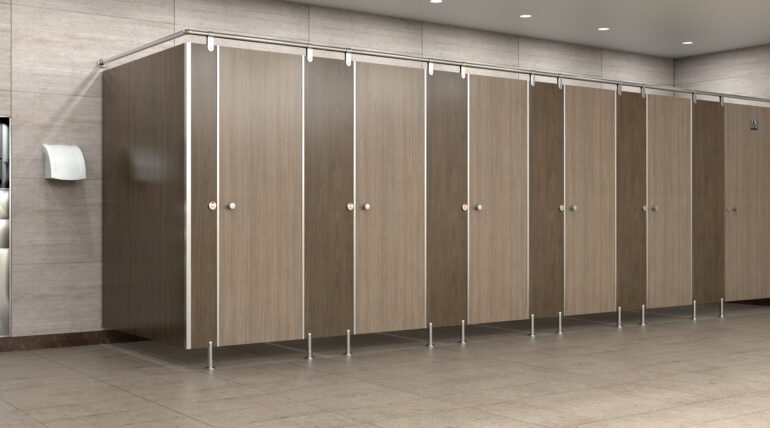
Washroom design has evolved significantly over the years, moving beyond basic functionality to focus on hygiene, durability, and aesthetics. One of the key elements driving this transformation is the use of modular toilet cubicles.
Restrooms are a fundamental requirement in all public and commercial buildings. Increasingly they have also become an integral part of overall building design, user experience, and hygiene standards. From offices and malls to schools and airports, they offer a practical, fast and significantly better approach to washroom planning.
What Are Modular Toilet Cubicle Systems?
Toilet cubicles are partitions that divide a washroom into multiple private units (like enclosures around commodes). Typically made from materials such as High-pressure compact laminate (HPL) or stainless steel, these systems are designed for durability, moisture resistance, and ease of maintenance.
They are modular, quick to install, and require no wet work or drying time. Available in various colours, sizes, and models, they can be configured as per available space and user requirement. Working with experienced toilet cubicle manufacturers in Mumbai ensures that these systems are not only aesthetically refined but also engineered for durability, hygiene, and long-term performance.
Key Reasons Why Toilet Cubicle Systems Are Essential:
1. Better Hygiene Standards
Hygiene is a key factor in modern washroom design. Materials such as High-Pressure Laminate (HPL) have a solid non-porous core and are.
- Moisture resistant
- Antibacterial, Antifungal
- Do not absorb moisture
- Reduce lingering washroom odour
Choosing the right toilet cubicle partition supplier in Mumbai ensures that materials meet hygiene and safety standards as per national and international norms.
2. Fast Installation
Unlike traditional brick-and-mortar toilet construction, which requires concrete, plastering and painting, modular cubicle systems are installed using dry methods.
Key benefits include:
- Ready panels cut and joint by sections and hardware
- No wet work or drying time
- Onsite cutting can accommodate minor site changes
- Faster project completion
- Reduces dependency on multiple agencies and simplifies coordination
This makes them ideal for both new projects and renovation works where project time and repair downtime have to be minimized.
3. Durability for High-Footfall and High-Traffic
Commercial restrooms are subject to constant use and require materials that can withstand wear and tear.
Modern cubicle systems are:
- Impact-resistant
- Water-resistant
- Designed for long-term structural stability
- Have 10-year material warranty
Compared to traditional materials, they can easily handle high footfall of stadiums, malls, offices, schools, public places etc with minimum maintenance and upkeep.
4. Design Flexibility and Aesthetic Appeal
Washroom design today is closely linked to the overall interior theme of a building. Toilet cubicles are available in a wide range of colours, textures, and finishes, allowing designers to create visually cohesive spaces in very short time intervals.
Options include:
- Rich Solid colours and Wood finishes
- Matte, gloss, or textured surfaces
- Custom prints, designs and vinyl
- Gold, rose gold, matt black, bronze hardware
- Bottom open, close, full height, ceiling hung and many more configuration options
This flexibility enables architects to design layouts aligned with the building’s aesthetics and user comfort.
5. Efficient Space Utilisation
Toilet cubicle systems are designed to optimize available space while maintaining comfort and usability.
- Traditional layouts have thick walls and feel bulky
- HPL panels are 12 or 18mm thick giving more free space
- Maximum utilization of restroom area
- Overall design is organized and clutter-free
This is especially important in commercial projects where space efficiency directly impacts functionality.
6. Easy Maintenance and Long-Term Cost Efficiency
One of the biggest advantages of modular cubicles is ease of maintenance.
- Bottom gap ensures one swipe cleaning
- Fast repeated cleaning cycles for high foot traffic areas
- Less corners and crevices
- Less dirt accumulation
- Quick replacement of components in case of damage
- Minimum downtime
- Reduced long-term repair costs
Over time, this results in significant savings in maintenance and operational expenses.
Applications of Toilet Cubicles
Toilet cubicles are widely used across various sectors, including:
- Corporate offices
- Malls and Multiplexes
- Schools, universities & hostels
- Airports, railway stations, and public infrastructure
- Hospitals and healthcare facilities
- Industrial and manufacturing units
Their adaptability makes them suitable for both small and large-scale projects.
Choosing the Right Toilet Cubicle Partner
Selecting the right supplier plays a crucial role in the performance and longevity of the system. A reliable toilet cubicle partition supplier in Mumbai will offer quality materials, on time delivery, and professional installation support.
Similarly, experienced toilet cubicle manufacturers in Mumbai ensure that the systems are designed to meet project-specific requirements, including durability, aesthetics, and compliance standards.
Key factors to consider include:
- Material quality and finish
- Hardware and fittings durability
- Lead time
- Customization capabilities
- Installation expertise
- After-sales support
Conclusion
Modular Toilet cubicles have become an essential component of modern washroom design due to their ability to combine hygiene, durability, and efficient space planning.
As commercial and public spaces continue to evolve, the demand for well-designed, high-performance washroom solutions is increasing. Modular toilet cubicles address these needs effectively, making them a practical choice for a wide range of applications.
Choosing the right system and working with experienced suppliers ensures a washroom design that is functional, elegant, user-friendly, and built to last.