
Modern workspaces are becoming increasingly technology-driven. From high-speed internet and power systems to communication networks and smart devices, offices today depend on a large amount of cabling and infrastructure to function efficiently.
Managing these services in an organized and accessible manner is one of the biggest challenges in workspace design. This is where raised access flooring systems play an important role.
Widely used in corporate offices, IT environments, and commercial buildings, raised flooring helps create cleaner, more flexible, and future-ready workspaces by improving cable management and infrastructure planning.
Understanding Raised Access Flooring Systems
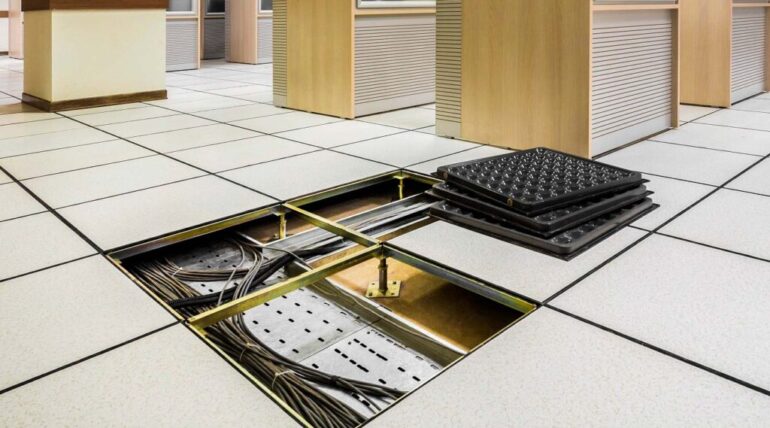
Raised access flooring systems consist of modular floor panels installed on adjustable pedestals above the structural floor. This creates an underfloor void that can be used to route electrical wiring, data cables, HVAC systems, and other services.
Unlike conventional flooring, where cables are often concealed within walls or surface trunking, raised flooring provides an accessible and organized pathway beneath the floor surface.
Importance of Cable Management in Smart Workspaces
Smart workspaces rely heavily on interconnected systems such as:
- Computers and servers
- Internet and networking infrastructure
- Communication systems
- Security and surveillance equipment
- Smart lighting and automation systems
Poor cable management can lead to clutter, maintenance difficulties, reduced efficiency, and safety risks. As offices become more dynamic and technology-intensive, organized infrastructure planning becomes essential.
How Raised Flooring Improves Cable Management
1. Organized Underfloor Cable Routing
One of the primary advantages of raised flooring is the dedicated underfloor space for cable routing.
Power cables, data lines, and communication wiring can be separated and arranged systematically beneath the floor. This helps maintain a clean workspace while reducing cable congestion.
Organized routing also makes it easier to identify and manage different systems during maintenance or upgrades.
2. Easy Accessibility for Maintenance
In traditional flooring systems, accessing concealed cables may require wall modifications or floor breakage.
Raised access flooring allows individual panels to be lifted easily, providing direct access to the underfloor area. This simplifies inspection, maintenance, and replacement of cables without disrupting office operations.
3. Flexibility for Workspace Changes
Modern offices frequently undergo layout changes due to expansion, restructuring, or evolving work styles.
Raised flooring supports this flexibility by allowing cables and service points to be reconfigured quickly. Workstations can be relocated without extensive rewiring, making the workspace more adaptable.
4. Reduced Visual Clutter
Visible wires and surface trunking can affect the appearance and organization of an office.
By routing cables beneath the floor, raised flooring systems help maintain a clean and professional environment. This contributes to better workspace aesthetics and improved employee experience.
5. Improved Safet
Unmanaged cables can create trip hazards and increase the risk of accidental damage.
Underfloor cable management minimizes exposed wiring, improving safety within the workspace. It also protects cables from wear and external interference.
6. Support for High-Density Technology Environments
Smart workspaces often involve a large number of interconnected devices and systems.
Raised flooring systems are designed to accommodate high cable volumes while maintaining accessibility and organization. This makes them suitable for offices with intensive IT and networking requirements.
7. Scalability for Future Technology Needs
Technology requirements continue to evolve, requiring offices to integrate additional systems over time.
Raised flooring provides the flexibility to add or modify cables without major structural changes. This scalability supports long-term infrastructure planning and future upgrades.
Applications in Modern Workspaces
Raised access flooring systems are commonly used in:
- Corporate offices
- Server rooms and Data centres
- IT parks, control rooms and meter rooms
- HUB room, UPS room, EPBX room
- Plant control rooms
- Command and monitoring centres
- Co-working spaces
- Smart commercial buildings
These environments benefit from efficient cable management and adaptable infrastructure.
Choosing the Right Raised Access Flooring Partner
The effectiveness of a raised flooring solution depends on the quality of the system and installation.
Experienced raised access flooring system manufacturers in India provide solutions designed to meet the infrastructure demands of modern workspaces. Factors such as panel strength, system precision, accessibility, and load performance are important considerations during selection.
A reliable manufacturer also ensures proper planning and execution based on workspace layout and service requirements.
Conclusion
In modern smart workspaces, infrastructure planning is just as important as interior design. As offices become increasingly dependent on technology, the need for efficient and adaptable cable management systems continues to grow.
Raised access flooring systems address this requirement by providing a structured underfloor space for routing power, data, and communication services. Beyond improving organization, they also support flexibility, easier maintenance, enhanced safety, and future scalability.
For businesses designing technology-driven work environments, raised flooring offers a practical solution that helps create cleaner, more efficient, and future-ready workspaces.