
Flooring plays a crucial role in defining both the functionality and aesthetics of a space. In commercial and residential construction, two commonly used systems are traditional flooring and raised access flooring systems.
While both serve the same basic purpose, their design, structure, and applications differ significantly. Understanding these differences helps in selecting the right flooring system based on project requirements.
What is Traditional Flooring?
Traditional flooring refers to floor finishes installed directly over a concrete slab. Materials commonly used include:
- Tiles
- Marble
- Granite
- Kota Stone
- Vinyl
- Wood
- Carpet
These systems are fixed in place and form a permanent surface once installed. Any services such as electrical conduits or plumbing are typically embedded within the slab or routed through walls.
Key Characteristics:
- Fixed and non-modular construction
- Wide variety of material and finish options
- Services planned before installation
- Suitable for spaces with stable layouts
What are Raised Access Flooring Systems
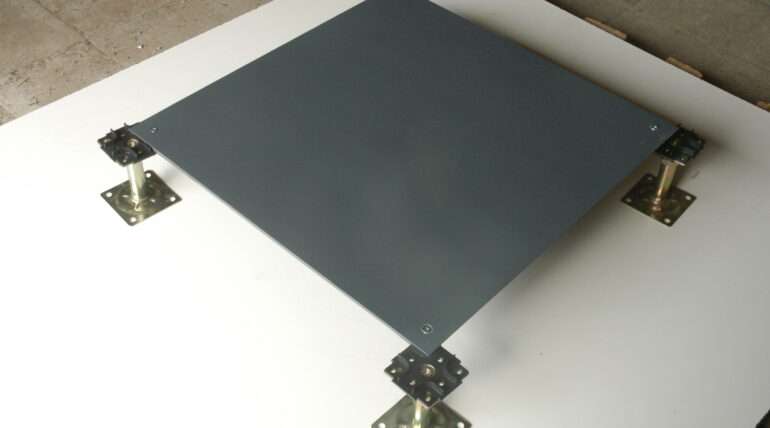
Raised access flooring systems consist of modular panels supported on adjustable pedestals, creating a pseudo floor between the structural floor and the walking surface.
This void acts as a service zone for electrical wiring, data cables, HVAC distribution, and other utilities. The panels can be individually removed for repairs and reinstalled again as needed.
Key Characteristics:
- Modular panel-based system
- Accessible underfloor service area
- High Load capacity
- Flexible and reconfigurable design
- Commonly used in service-intensive environments
Key Differences Between Raised Flooring and Traditional Flooring
1. Structural Design
Traditional flooring is installed directly onto the base slab, forming a continuous and permanent surface.
Raised access flooring systems are elevated above the slab using a grid of pedestals and stringers, creating an accessible void beneath the floor.
2. Flexibility and Modifications
In traditional flooring, modifications often involve breaking and relaying new tiles on the floor, especially when accessing concealed services.
Raised flooring allows individual panels to be lifted and repositioned, enabling easier repairs or layout changes without major disruption.
3. Service Integration
Traditional flooring requires services such as electrical conduits and plumbing lines to be pre-planned and embedded within the slab or walls.
Raised access flooring systems provide a dedicated underfloor space where services can be routed, modified, or expanded over time.
4. Maintenance and Accessibility
Accessing services in traditional flooring systems can be time-consuming and invasive, often requiring surface damage.
In raised flooring systems, panels can be removed to access the underfloor area, making maintenance and upgrades more straightforward.
5. Installation Process
Traditional flooring typically involves wet processes such as mortar application, curing, and finishing polish.
Raised access flooring systems use a dry modular installation method, where panels and pedestals are assembled on-site, allowing for faster execution.
6. Aesthetic Considerations
Traditional flooring offers a broader range of natural materials and finishes, making it suitable for spaces where visual appeal is a primary consideration.
Raised flooring systems also offer various surface finishes, including laminates, vinyl, and carpet tiles, while maintaining a clean appearance by concealing services.
7. Cost Dynamics
Traditional flooring generally involves lower initial costs, depending on material selection.
Raised access flooring systems may require a higher upfront investment due to their structure and components, but they can offer cost advantages over time in projects requiring frequent modifications or service access.
Applications of Each Flooring System
Traditional Flooring is commonly used in:
- Residential spaces
- Hotels and hospitality areas
- Retail environments
- Areas with minimal service integration requirements
Raised Access Flooring Systems are commonly used in:
- Data centers and server rooms
- Control rooms and command centers
- IT and telecom facilities
- Corporate offices and banks
- Spaces with high cabling and service density
Choosing the Right Raised Access Flooring Manufacturer
When selecting a raised access flooring manufacturer, it is important to consider factors such as product quality, load performance, system design, certifications and installation expertise.
A reliable manufacturer ensures:
- Consistent panel strength and durability
- Compliance with national and international standards
- Compatibility with project requirements
- Efficient and clean execution
- Certifications and after sales support
Inner Space, with over 30 years of industry experience, provides raised access flooring systems designed to meet the evolving needs of modern commercial spaces.
Conclusion
Both traditional flooring and raised access flooring systems have distinct characteristics that make them suitable for different applications.
Traditional flooring remains a preferred choice for spaces with stable layouts and aesthetic design-focused requirements. Raised access flooring systems, on the other hand, are widely used in environments that demand flexibility, service integration, and easy accessibility.
The choice between the two depends on the functional needs, future adaptability, and nature of the space.